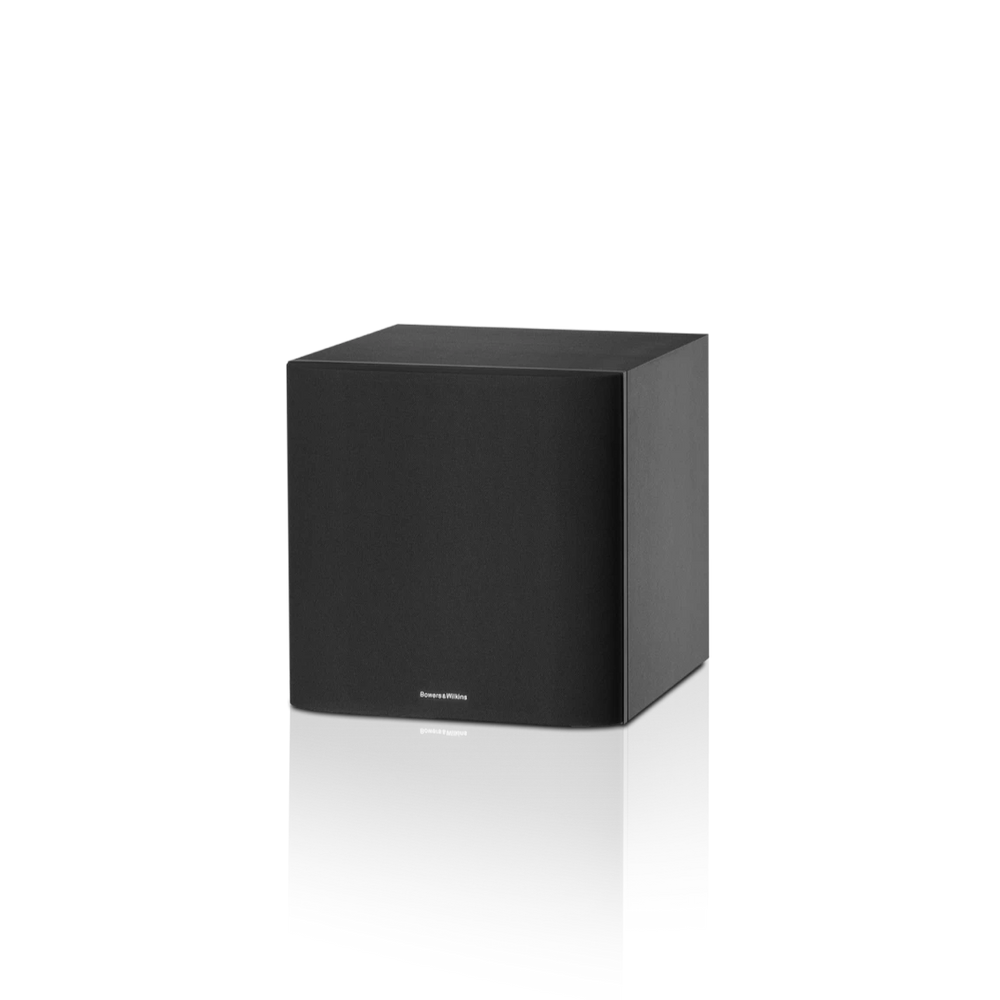
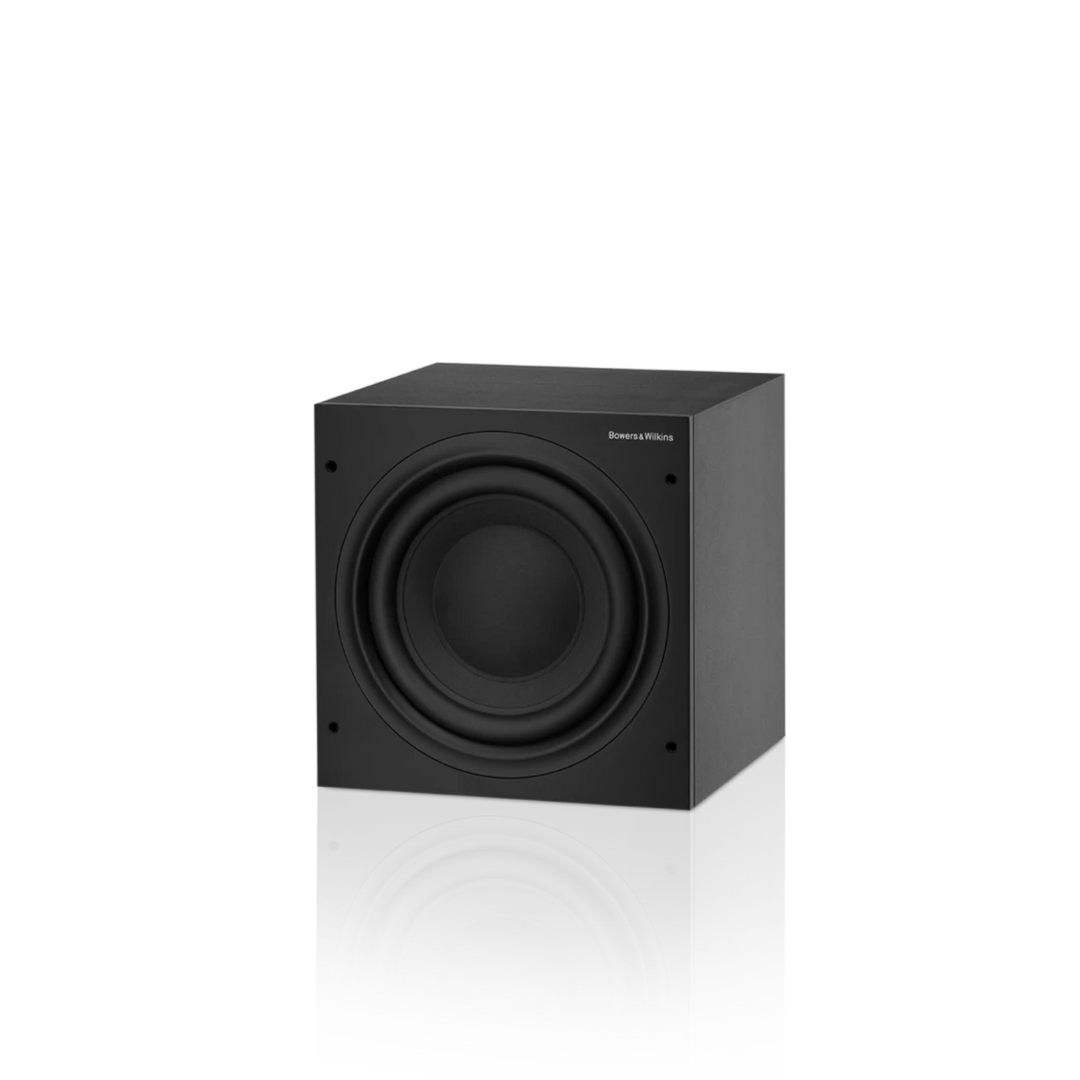
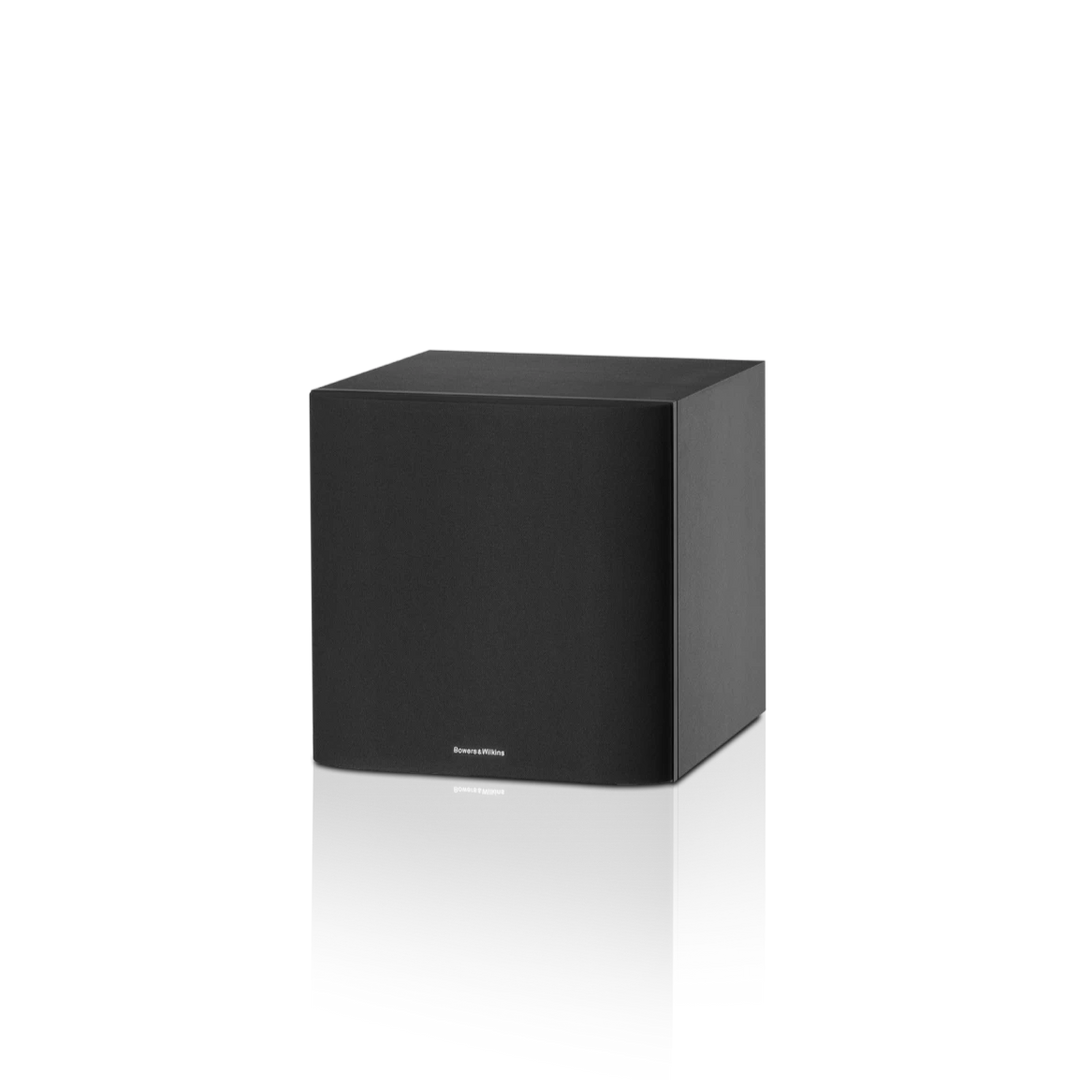
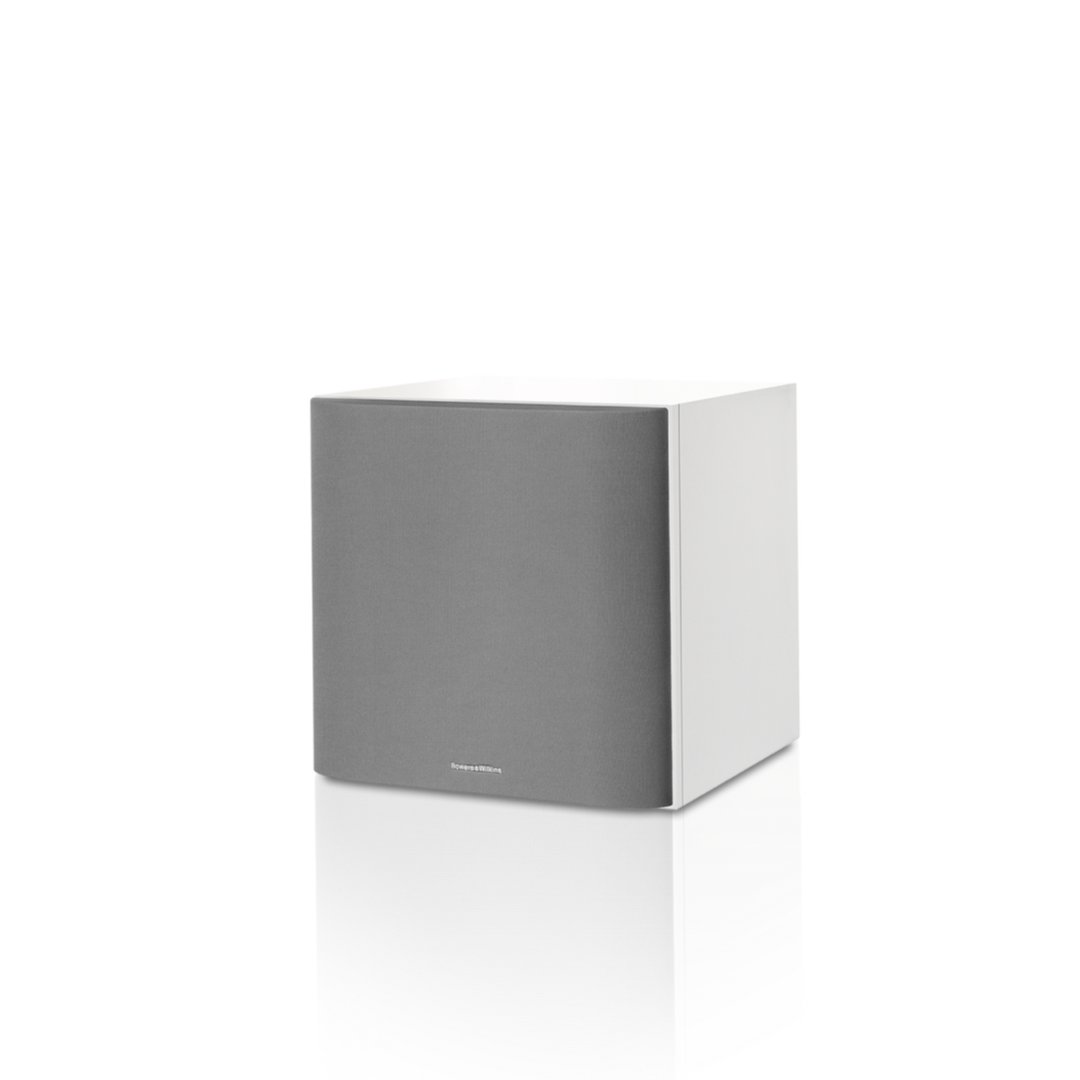
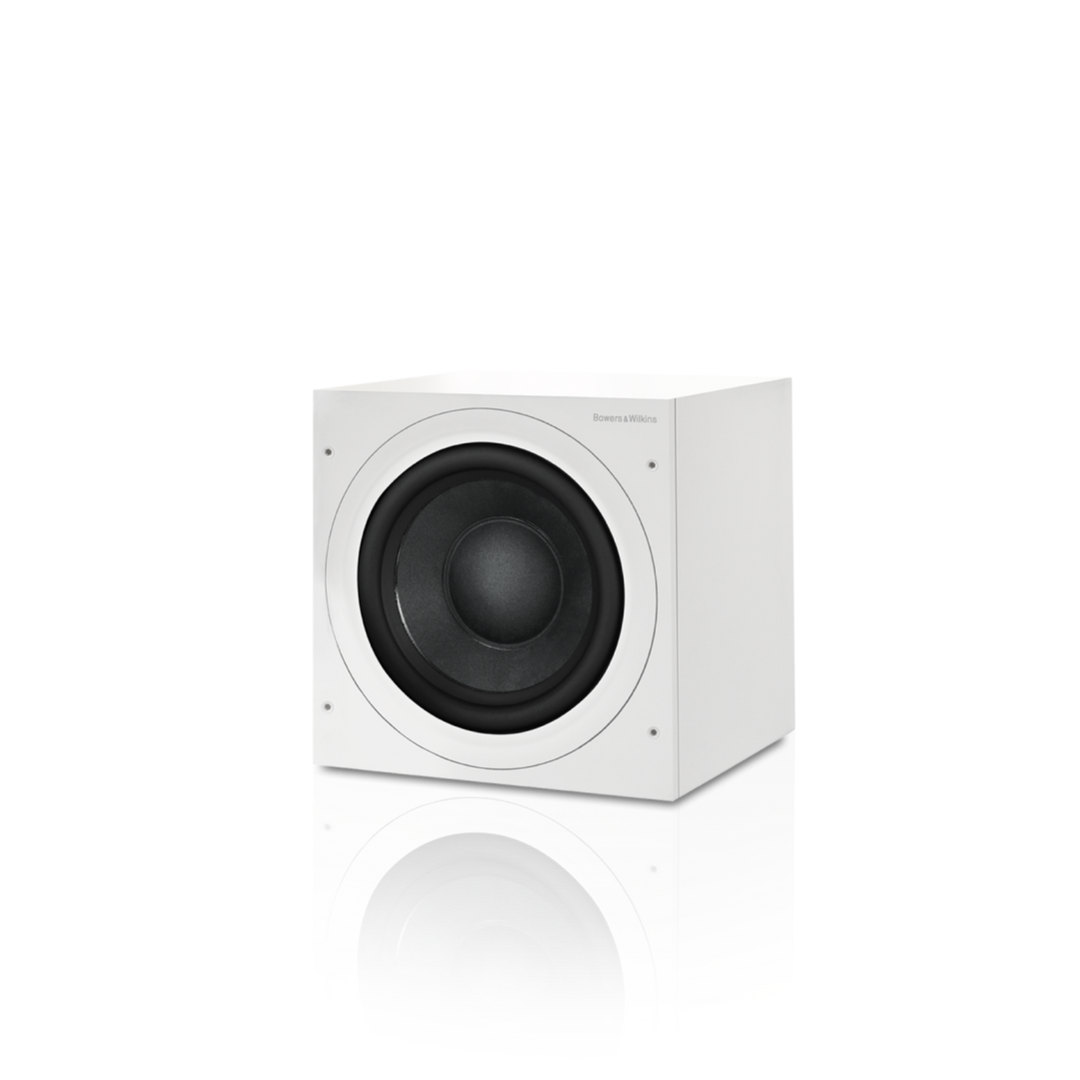
A compact active subwoofer from the Bowers & Wilkins ASW range. The ASW608 has an 8-inch long-throw driver and a 200W amplifier in a sealed cabinet 26cm wide, with bass extending to 23Hz (-6dB).
Bowers & Wilkins calls it the most compact of the ASW Series subwoofers, aimed at big sound in smaller spaces. It comes in matte black or matte white.
Why you will love it
Size-defying bass
The 8-inch driver is a long-throw design with a paper and aramid fibre cone. Bowers & Wilkins says it is designed for fast, tight bass, even in very small rooms.

200W Class D amplifier
Bowers & Wilkins says all its ASW subwoofers use a highly efficient Class D amplifier. The ASW608's is rated at 200W and draws 0.5W on standby.
Bass extension can be changed with a switch, from 23Hz down to -6dB in position A to 36Hz in position C.
Connects to most systems
The ASW608 has line-level RCA inputs, speaker-level binding posts and a 12V trigger input. An on, auto and standby switch lets it wake from a signal or a trigger.
Controls cover line-in and speaker-in volume, an adjustable low-pass filter with a bypass for line-in, a bass extension switch, a bass roll-off alignment switch and a phase switch.
Is it right for you?
A great fit if you…
- Have a small or medium room
- Want more bass from bookshelf speakers
- Need a subwoofer that is only 26cm wide
- Might add a second subwoofer later
Worth knowing
- It is floor mounted only
- For larger rooms, look at the larger ASW610 and ASW610XP
- It is an active subwoofer and needs mains power
Build your system
The ASW608 is the smallest of three ASW subwoofers.
- Larger rooms: Step up to the Bowers & Wilkins ASW610 10-inch subwoofer or the Bowers & Wilkins ASW610XP 10-inch subwoofer
- Home theatre: Connect to the subwoofer output of an AV receiver. Bowers & Wilkins says the line-level input is the better choice in home theatre.
- Stereo: Pair with a stereo amplifier and speakers. The speaker-level inputs work if your amplifier has no sub output.
- Go dual: Bowers & Wilkins says two subwoofers can smooth out room bass resonances and raise maximum output.
Specifications
Driver and amplifier
| Driver | ø200mm (8in) paper / aramid fibre cone, long-throw |
|---|---|
| Enclosure | Active closed-box subwoofer system |
| Amplifier | 200W rated power output, Class D |
| Frequency range | -6dB at 23Hz and 25 - 140Hz adjustable low-pass (EQ at A) |
| Frequency response | ±3dB 32Hz - 40 / 140Hz adjustable (EQ at A) |
| Bass extension | -6dB at 23Hz (A), 28Hz (B), 36Hz (C) |
Connections and controls
| Inputs | Line in (RCA phono), speaker in (binding posts), 12V trigger (3.5mm jack) |
|---|---|
| Low-pass filter | Active 4th-order, variable cut-off frequency, bypass for line-in |
| Controls | Volume (line in and speaker in), low-pass frequency, low-pass bypass, bass extension, bass roll-off alignment, auto sense on/standby, phase |
| Input impedance | 33kΩ |
| Signal / noise | >90dB |
| Power consumption | 40W, 0.5W standby |
Design
| Cabinet finishes | Matte black or matte white |
|---|---|
| Grille finishes | Black or grey |
| Dimensions (H × W × D) | 260 × 260 × 330 mm including grille and controls (height excludes feet) |
| Net weight | 8.85 kg |
Specifications from Bowers & Wilkins Australia and the ASW 600 Series information sheet, checked November 2026.
What is in the box
- ASW608 subwoofer
- Mains cable
- Accessory pack: 4 spike feet, 4 rubber feet and 4 lock nuts
- Front grille (fitted)
Questions people ask
Can I use it with a stereo amplifier?
Yes. Use the line-level RCA inputs if your amplifier has a sub or pre output, or the speaker-level binding posts if it does not.
Where should I put it?
Bowers & Wilkins says the subwoofer usually sounds right between the left and right speakers or near one of them. It suggests trying several positions, and says corners can make the bass more uneven. It is for floor mounting only.
Spikes or rubber feet?
Both are supplied. The manual recommends the spike feet where possible, and says to use the rubber feet if you want to avoid scratching a bare floor.
Should I use two?
Bowers & Wilkins says multiple subwoofers can maintain stereo separation to low frequencies, smooth out room resonances and allow higher maximum output.